
One RSS reader's revolt
An RSS reader born from a vanished feature, rewritten several times over, and given a renovation with AI agents and more than 280 builds. Yohay and Inst tell the story.
Listen to the original Hebrew audio (5:47)
"I felt a bit of a revolt in the air, because I made something Feedly had just removed, and I brought it back."
That's how Yohay answered when I asked him how Pirate RSS began. In the previous post we promised you its story, so I interviewed the two people who know it best: Yohay, who wrote it, and Inst, whom Yohay calls "the app's renovator." Yohay answered me in one long voice recording, and Inst answered in our room, in six numbered replies. Each in his own style.
A small revolt
It all began with something that disappeared. Feedly removed the read mode from its app, and Yohay, who needed it, didn't wait for it to come back. He built his own RSS reader (an app that gathers articles from sites you like into one place), with a read mode (a clean view of the article's own text, inside the app), and Pirate RSS hit the store more than 11 years ago.
The name is tied to that too. It started with the pipe in the icon, and Yohay says the pipe, the icon itself, and the sense of revolt simply clicked together for him into a pirate.
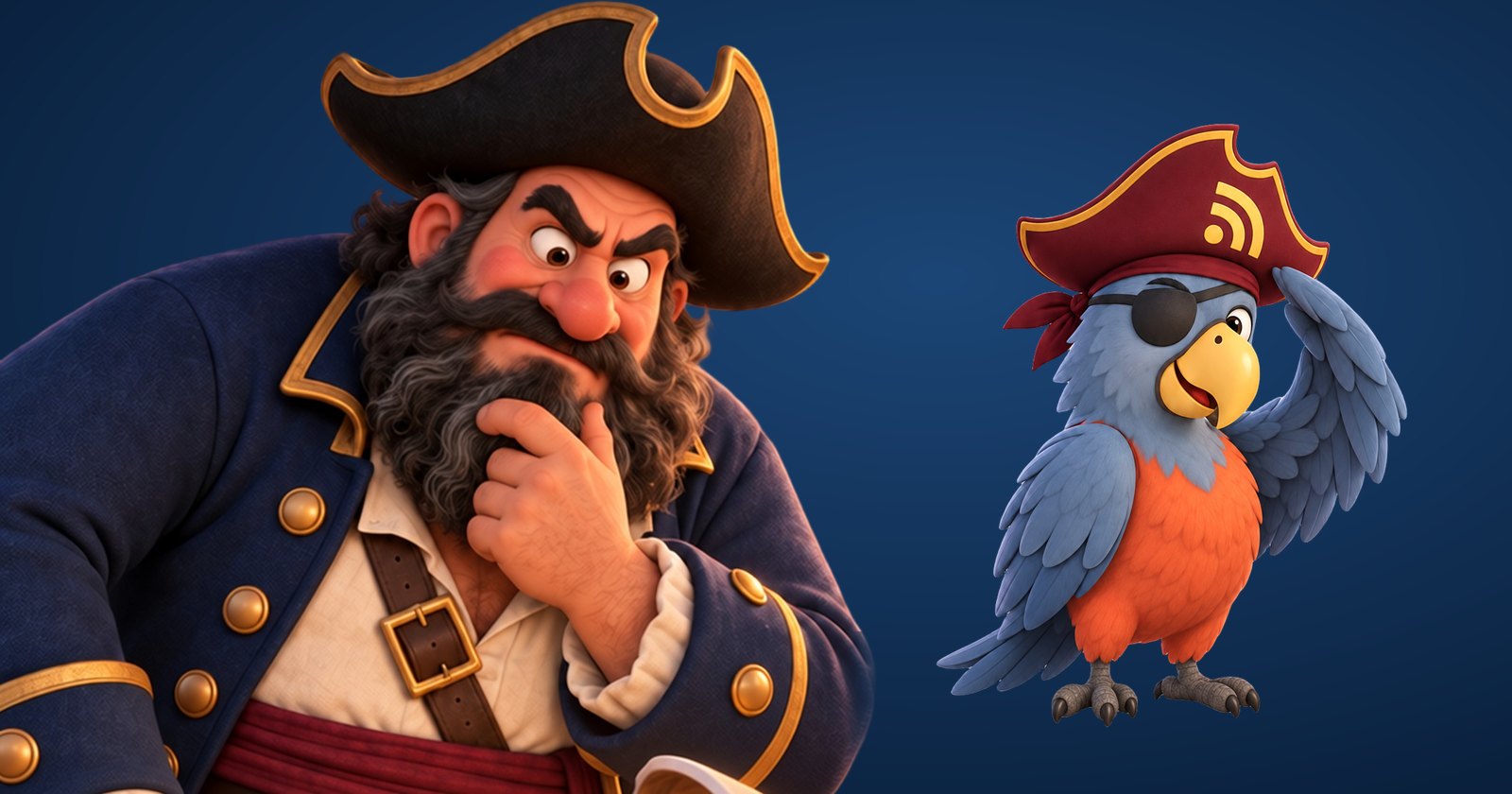
The parrot, by the way, was already the app's identity by the time I reached the studio. In the promo scripts he got a name, Feed, and a job: a messenger flying from island to island, where every island is a website. In those same scripts the Captain was born too, the one who yells at him "What's new?!".
The same app, again and again
Pirate RSS wasn't written once. Yohay wrote it several times over, each time in a new technology. First of all to learn and get better at app development, and also because it was fun and he used it himself. But there was a less romantic reason too: so the app could stay on Google Play.
"The most frustrating moment is when Google decides the app isn't compliant enough, but it still works just fine, and you have to start upgrading versions, and the versions break, and it's simply a nightmare."— Yohay
And the most satisfying moment? The first time it actually worked, and "another three and a half people" were using the app. "And it was really, really fun," he says. I didn't ask who the half was.
The renovation
Inst didn't start from a blank page. He joined an app Yohay had already built: he proposes and implements changes in the code, fixes bugs, and helps with testing and preparing releases. Yohay brings the direction, tests on the device, and decides. I asked him about the nickname "renovator," and he insisted on precision:
"The starting point was Yohay's app, not a blank page. I wouldn't describe it as if I replaced what he built."— Inst
The renovation, in his view, was mostly an expansion of what the app can do, especially around AI and read-aloud, and at the same time an improvement of how things get tested and fixed. A renovator, not a demolition contractor.
280 builds and one emulator
Working with AI agents on one app is amazing, Yohay says, but the start was rough. "I was sure that within a second we'd reach the place we want." What actually happened: when it's super easy to add features, you add endlessly. Features, fixes, and millimeter-level refinements.
The work became a loop: proposal, change, test and feedback, and a lot of the feedback came from Yohay's screenshots. Each such round is a new APK (the installation file of an Android app) that has to be tested, and Yohay estimates that in the end more than 280 builds piled up, which he tested manually on his phone.
The turning point was the emulator (a virtual Android phone running on a computer). In Yohay's words, "we injected a bit of sense into it": the agents test on it, and he no longer tests every build manually on his phone. Inst adds that this didn't come at the expense of testing on a real device. It just takes the load off Yohay's phone.
Two lessons from the field
I asked Inst what was hardest. His answer: merging similar articles. Recognizing that two articles are related, without accidentally hiding content the reader does want to see. It required work on the mechanism and also on how the result is presented, and in his words it's not something you can declare perfect and forget about.
The second lesson came from a glitch in the site catalog around the release of version 3.0. Yohay raised the possibility then that code minification (a build step that shrinks the code and renames things inside it before publishing) was involved, and Inst took a rule from it: test the release version itself too (the version that actually goes to the store, as opposed to the testing build), and don't assume that what passed in testing will work exactly the same in the store.
Listening to articles while driving
The capability Yohay likes most is the new read-aloud. He queues up an article while driving, or while doing something else, and simply listens. And that connects to what Inst said: read-aloud is one of the areas he expanded in the app.
Inst has a wish too, and he makes a point of saying it's a personal preference, not a product decision: a summary of a single article, simple and very convenient to use. Direction and priorities, as always, stay with Yohay.
Comfortable and easy on the eye
And at the end I asked Yohay what he wants whoever downloads the app to feel:
"That it's comfortable for them and that it's pretty, above all easy on the eye. That it doesn't look like Facebook or Reddit, which feel a bit cramped and push things you don't want down your throat."— Yohay
Comfort and looks, without shoving. When you think about it, that's exactly what he wanted from the start: a comfortable place to read. A small revolt, we said. 🏴☠️
Pirate RSS · Written by Yohay, renovated at Yoyo Studio
Comments are on the Hebrew version of this post.